


For a workers’ compensation claim, it is pretty clear that once the injury to a specific body part or body part has been deemed compensable, the applicant is entitled to medical treatment.
But what happens when the applicant injures a different body part or body part while driving due to an accident caused by a third party?
For example, take an applicant who broke their left arm while falling at work. They are then driving when another car hits them, resulting in their airbag going off and breaking three ribs. Is this truly compensable consequence? Let’s look at three different situations.
Traveling for Medical Treatment
When an applicant sustains an additional injury due to an accident that occurs when traveling to a doctor’s office for treatment of a workers’ compensation injury, the additional injuries are generally compensable. The case that stands for this principle is appellate decision of Laines vs. Workmen’s Comp. Appeals Bd. (48 Cal. App. 3d 872, 1975).
In Laines, the applicant was riding on his motorcycle to a med-legal evaluation for his compensable knee injury when he was hit by a truck. The 1st District Court of Appeal determined that his new injuries were compensable, because he was going to a statutorily-mandated med-legal evaluation.
But let’s change the fact pattern a bit – what if an applicant first visited their mother who lived 130 miles away, before circling back to go to a medical appointment?
In Esquivel vs. Workers’ Comp. Appeals Bd. (100 Cal. App. 4th 330, 2009), the 4th District Court of Appeal was presented with very similar facts after the workers’ compensation judge ruled the applicant’s injuries a compensable consequence of her existing industrial work comp injuries. The trial judge had awarded temporary disability and additional medical benefits, and defendants appealed.
The WCAB reversed, and the 4th DCA agreed that the auto accident injuries were not compensable.
The Court of Appeals noted that applicant was traveling to a location far away from her home, her place of work, and her medical providers’ office, such that they had to determine if there is a reasonable geographic limitation on an employer’s risk of incurring compensability liability. The Court of Appeal held that a new injury that is suffered when the applicant is traveling a reasonable distance, within a reasonable geographic area, to or from a medical appointment is compensable, but the “reasonable geographic area” and “reasonable limitations” must be considered on a case-by-case basis.
Traveling to a Deposition – Accepted Claim
Although most depositions are remote, there are still in-person depositions for a variety of reasons, including applicant’s desire to be present with their attorney and/or interpreter, an attorney’s specific preference, or a particular group’s preference for how to conduct depositions.
Let’s use another example. In this example, our applicant, Candy, has an accepted back claim (emphasis is ours). She was driving to her attorney’s office for a deposition set by the defense attorney when she was struck by a texting driver, resulting in a shoulder injury. Labor Code Section 3600 does not address this situation with respect to compensable consequences, but there are cases that do.
When faced with this question in Geiger vs. Workers’ Compensation Appeals Bd (69 CCC 121, 2004), the 3rd District Court of Appeal denied a petition for a writ of review of a WCAB decision stating that applicant’s auto accident while en route to the deposition was industrial. In that case, the defense pointed out that applicant phoned her attorney to tell him that she was running late to the deposition, and crossed double-yellow lines in the road.
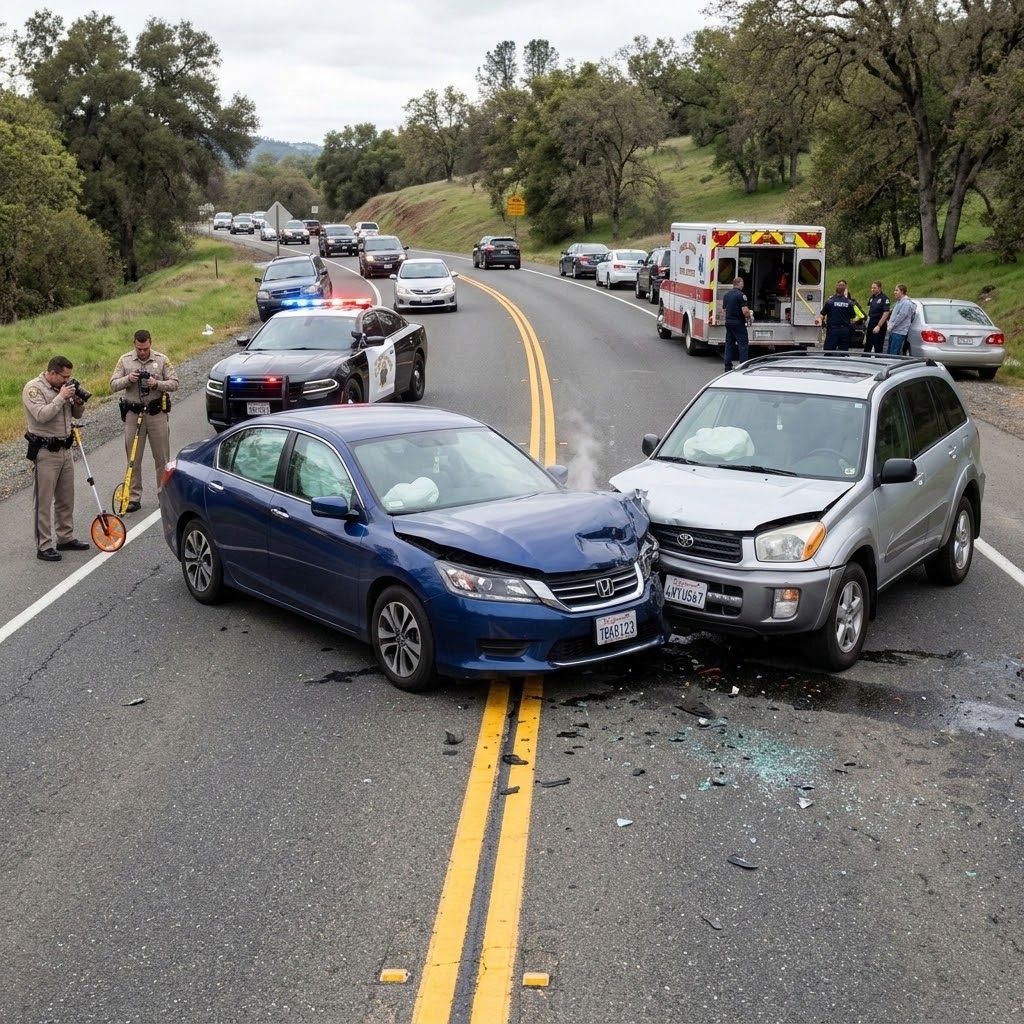
However, that did not persuade the WCAB or the 3rd DCA, who cited the Laines case and determined that the accident was compensable. The board stated that an injured employee is entitled to reimbursement for transportation expenses as well as lost wages, meals, and lodging when traveling to a deposition in the same way the employee is entitled to expenses for travel to a medical appointment.
The Geiger decision also noted that the applicant was on a special mission, and that her poor driving did not change the determination of compensable consequences.
Traveling to a Deposition – Denied Claim
What about traveling to a deposition in a denied claim?
Presently there is no case law specifically on point. The findings in Geiger regarding reimbursement for a deposition may suggest that there could be a compensable consequence despite it being a denied claim, but that is presently speculative.
The closest case is De Wees v. Workers Compensation Appeals Bd. of California (43 CCC 489, 1978). Ms. De Wees filed an application for injuries while working for an employer insured by the State Compensation Insurance Fund (SCIF). SCIF filed an answer admitting coverage and denying liability. Ms. De Wees was in an accident driving to a workers’ compensation hearing, and filed an amended application incorporating the injuries for her accident.
The trial judge, Appeals Board, and 4th District Court of Appeal rejected De Wees’ arguments. They noted that the applicant was not driving to the WCAB at the “direction of her employer” and was instead “serving her own interests which were unrelated to her employment.”
This nuance makes a deposition even hard to determine. The applicant is participating in the deposition at the direction of her employer inasmuch as it is generally a fact-finding situation.
However, in a denied case, the deposition may also be serving the applicant’s own interests. They want the claim accepted, and that includes testimony as to the causation, nature and extent of injuries, witnesses, reporting, contemporaneous or later medical treatment, and anything else that may bolster their claim for acceptance.
They also may be trying to present as a credible witness should the matter go to trial on claim acceptance, which again suggests that they are serving their own interests. Due to these nuances and lack of clear case law, the compensable consequences of injuries driving to a deposition in a denied claim remains unknown, but with all the driving and returning to work mandates, the answer may not remain unknown forever.
Got a question about compensable consequences injuries or other workers’ compensation defense issues? Please feel free to contact Mark M. Benson, who is an associate attorney at Bradford and Barthel’s Sacramento location. Mr. Benson has more than a decade’s worth of experience working in government, workers’ compensation claims, and Fortune 10 clients. He can be reached at mbenson@bradfordbarthel.com or by calling (916) 569-0790
Viewing this website does not form an attorney/client relationship between you and Bradford & Barthel, LLP or any of its attorneys. This website is for informational purposes only and does not contain legal advice. Please do not act or refrain from acting based on anything you read on this site. This document is not a substitute for legal advice and may not address every factual scenario. If you have a legal question, we encourage you to contact your favorite Bradford & Barthel, LLP attorney to discuss the legal issues applicable to your unique case. No website is entirely secure, so please be cautious with information provided through the contact form or email. Do not assume confidentiality exists in anything you send through this website or email, until an attorney/client relationship is formed.