


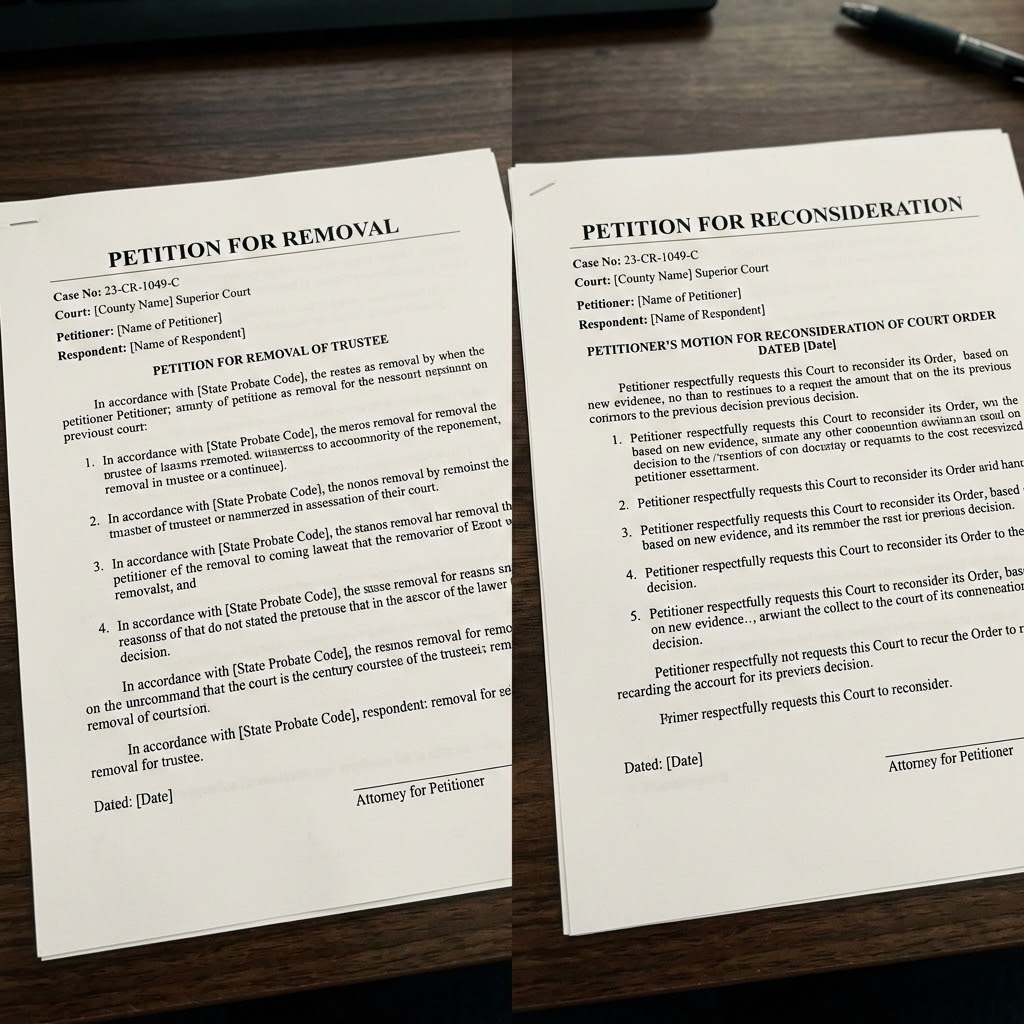
One topic that has regularly arisen in countless panel decisions over the years, yet still is the subject of much confusion, is whether a party disputing a trial judge’s decision should file a petition for removal or a petition for reconsideration.
The Workers’ Compensation Appeals Board attempted to address the confusion in the 2024 significant panel decision of Latrice Reed v. County of San Bernardino, 89 Cal. Comp. Cases, 11/5/24. Perhaps the most important takeaway from that panel decision was that inappropriate petitions for reconsideration are potentially sanctionable.
Your humble blogger learned this early on, as former WCAB Chairwoman Ronnie Caplane and Commissioner Alfonso Moresi routinely warned attorneys at numerous seminars that filing the wrong petition could lead to sanctions. Even when the WCAB does not issue sanctions, it’s common for them to issue a stern admonishment against the party who filed the wrong petition before delving into the WCAB’s panel decision on the topic at issue.
A SIMPLE EXPLANATION
To put it simply, a petition for reconsideration is only appropriate when a party is disputing a “final order” from a judge.
For non-final orders, which are also known as interlocutory orders, the challenging party’s remedy is to file a petition for removal with the WCAB.
EXAMPLES
Even the most seasoned attorneys’ eyes glaze over when we use the word “interlocutory” in conversation. Fortunately, sometimes things are best explained by example. Here are some examples:
- A MSC judge sets a case for trial over a party’s objection. = Interlocutory Order warranting a petition for removal.
- A trial judge issues a ruling on a discovery issue, such as a ruling on whether a party’s QME request was valid. = Interlocutory Order warranting a petition for removal.
- A trial judge issues a Findings and Award on AOE/COE, causation, TD, PD, apportionment. = Final Order warranting a petition for reconsideration.
- In a denied case, a trial judge issues a Findings and Award finding the injury was indeed AOE/COE. = Final Order warranting a petition for reconsideration because this resolves a threshold issue that is effectively a final decision on industrial causation. (This last example is somewhat arguable, but still it’s my humble opinion that this is a final order.)
WHY IS IT IMPORTANT?
The difference between the two types of petitions is particularly important because a petition for reconsideration creates a whole lot of work for the trial judge and Appeals Board, places a procedural “freeze” barring the judge from issuing other rulings on the case, and requires the WCAB to take action within 60 days of the petition being transferred to the Appeals Board’s Reconsideration Unit.
While a petition for removal also creates work for the trial judge, it does not restrict the judge from issuing other rulings on the case, or mandate some kind of decision within 60 days.
For both petitions, the judge can rescind or resolve their initial ruling, and if not resolved, must issue a report within 15 days to the Appeals Board’s Reconsideration Unit.
WHAT IF YOU REALLY AREN’T SURE?
One practice tip is to:
- Do your best to really focus on which petition is right for your dispute,
- Explain your argument for that type of petition in the first two pages of your petition,
- Then add a clause stating that if this type of petition is inappropriate, that you’re alternatively pleading it as the other type of petition.
While imperfect, this type of pleading will at least show the WCAB that a) you were thoughtful enough to try and file the right petition, and b) your reasons for doing so.
Now compare that approach to the opposite extreme – the party who carelessly files the wrong petition and still demands action from the WCAB.
If you’re a WCAB staff attorney reviewing petitions, you will likely be more lenient with the former, and take a harsher view to the latter.
CONCLUSION
Before you write your petition for reconsideration/removal, evaluate the order you’re disputing and which type of petition is appropriate for your dispute. Then, after you’re done writing your petition and are proofreading it, run the same analysis again.
This will ensure that you are starting off with the right approach to your legal dispute. Starting off with the wrong type of petition indicates carelessness to the WCAB, which is not the best approach when asking the WCAB to do you a favor and to overturn the trial judge’s ruling.
Got a question about workers’ compensation defense issues or pending legislation? Feel free to contact John P. Kamin. Mr. Kamin is a workers’ compensation defense attorney and partner at Bradford & Barthel’s Woodland Hills location, where he monitors the recent legislative affairs as the firm’s Director of the Editorial Board. Mr. Kamin previously worked as a journalist for WorkCompCentral, where he reported on work-related injuries in all 50 states. Please feel free to contact John at jkamin@bradfordbarthel.com or at (818) 654-0411.
Viewing this website does not form an attorney/client relationship between you and Bradford & Barthel, LLP or any of its attorneys. This website is for informational purposes only and does not contain legal advice. Please do not act or refrain from acting based on anything you read on this site. This document is not a substitute for legal advice and may not address every factual scenario. If you have a legal question, we encourage you to contact your favorite Bradford & Barthel, LLP attorney to discuss the legal issues applicable to your unique case. No website is entirely secure, so please be cautious with information provided through the contact form or email. Do not assume confidentiality exists in anything you send through this website or email, until an attorney/client relationship is formed.